Diagnosis
Repair, lift, or replace
Three different jobs at three very different prices, and the difference between them is visible from the end of the driveway if you know what you are looking at.
The most expensive mistake with a failing driveway is not choosing the wrong contractor. It is buying the wrong job. Replacing a slab that only needed lifting wastes most of the money. Lifting a slab that has structurally failed wastes all of it. Sealing cracks in a drive that is coming apart is a way of spending money slowly. Getting the diagnosis right first is worth more than shopping the price afterwards.
Start by walking it
Go out and look at the drive properly, ideally on a bright morning when shadows show relief. Four things tell you most of what you need to know.
- Are the pieces still level with each other? Run a foot along each crack. If one side is higher, the slab has moved, not just cracked.
- How many panels are affected? Two or three cracks across a whole driveway is a different situation from cracking in most panels.
- What do the edges feel like? Firm edges that do not crumble under a shoe mean the concrete itself is sound. Edges that crumble mean the material has deteriorated.
- Is anything changing? Mark a crack width with a pencil and a date. A crack that is the same in three months is a different animal from one that is not.
Case one: sealing and minor repair
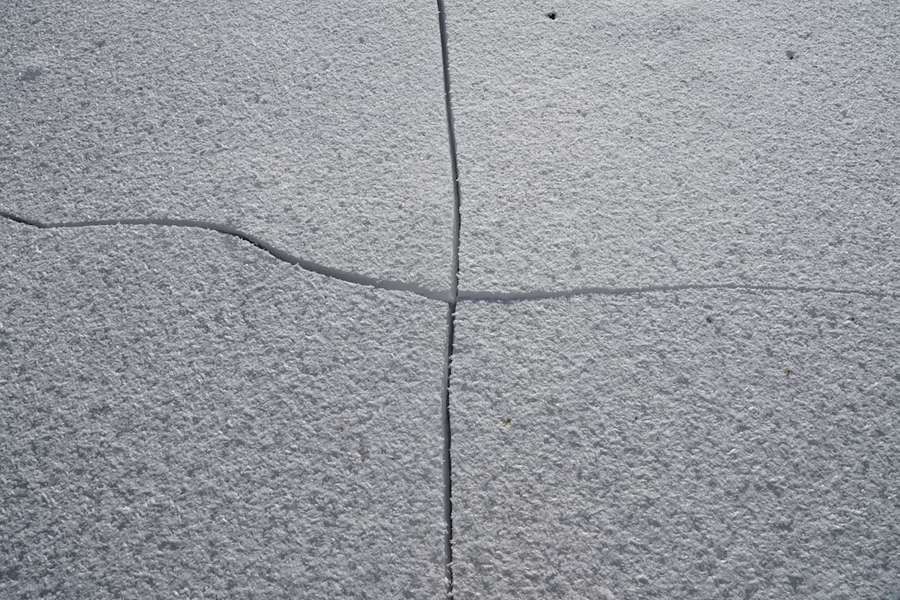
A slab with a small number of tight cracks, no step across them, sound edges, and no measurable change over months is a maintenance job. The right work is sealing the cracks and the joints with a flexible sealant so water cannot get underneath, where it does the damage that matters. Around Conroe, keeping water from running under the slab edge is the single most useful preventive thing you can do, because the subgrade here is sandy and water moving under an edge carries it away.
Fine shrinkage cracking that appeared in the first year is normal and expected. Concrete shrinks as it cures; joints exist to give that shrinkage a planned place to go, and where it goes somewhere unplanned but stays tight, sealing it is the whole answer.
Case two: lifting a settled panel
This is the case most often missed, and it is the one that saves the most money. A panel that is still in one piece but has dropped relative to its neighbors has not failed as concrete. The ground under it moved. Injection lifting fills the void beneath through small drilled ports and raises the panel back toward grade, and it is considerably less disruptive and less expensive than removal and replacement.
The test is whether there is still a panel to lift. One or two tight cracks in a panel is usually fine. A panel broken into several pieces has nothing left that will move as a unit.
Around here, the usual reasons a panel drops are worth knowing because they tell you whether it will happen again. Backfill over a utility trench that was never properly compacted is the classic. Fill over a culvert crossing that has consolidated is the rural version. And water running under the slab edge and carrying sandy subgrade away with it is the one that repeats: lift the slab without fixing where the water goes and you will be lifting it again. A repair quote that does not mention drainage is an incomplete quote.
Newer subdivisions around Magnolia, New Caney, and the growth corridors are where this pattern shows up most, because houses there sit on relatively recent fill and a slab five years old that has stepped at a joint has settled rather than worn out.
Case three: partial replacement
Concrete is placed in panels separated by joints, which means a single failed panel can be sawcut at the joints, removed, and repoured without touching the rest of the drive. The apron in front of a garage is the most common candidate, because it takes every vehicle entry and sits where two structures with different foundations meet. The approach at the street is the second, for similar reasons.
The honest caveat is color. A new panel will not match a twenty-year-old one, and it will stay visibly different for a long time, because concrete lightens and weathers slowly. Where appearance matters, that trade is worth weighing before the saw comes out. Where it does not, partial replacement is often the best value on this list.
Case four: full replacement
A slab has reached the end when cracking runs through most of the panels, when pieces have moved relative to each other in several places, when edges crumble, or when the surface has deteriorated to the point that resurfacing would be bonding new material to a weak layer. At that point there is no structure left to preserve, and money spent patching is money spent twice.
There is a hidden benefit to replacement worth naming: demolition is the only time anybody gets to see the subgrade. A slab that comes up over firm sand failed from age or from being poured too thin. One that comes up over a hollow, or over clay that has been holding water for years, failed because of what was underneath, and pouring a new slab into the same conditions repeats the result on a slower clock. That information is available for free on demolition day and nowhere else, which is why it is worth having somebody looking rather than just breaking.
Surface problems are their own category
Scaling, where the top layer flakes away leaving a rough pitted face, is a durability problem rather than a structural one. It comes from a weak surface skin, usually created by water worked into the surface during finishing, finishing carried out over bleed water, or curing stopped too early. The slab underneath can be perfectly sound.
Resurfacers exist, and their success depends entirely on what they are bonding to. A thin topping applied over the same weak layer that failed will fail with it. An honest assessment here means somebody testing what is left rather than quoting a product, and it means being told when the answer is that resurfacing will not hold.
What a good assessment looks like
- Somebody walks the whole drive rather than looking at the worst spot from the truck
- The cause is named before the method: settlement, root lift, age, or surface failure
- Where the water goes gets discussed, because on this ground it usually is the story
- More than one option is priced where more than one option exists
- Color match is raised honestly if partial replacement is on the table
- You are told what will still be uncertain until demolition, rather than told nothing
For what a replacement job involves, see driveway replacement and removal, and for lifting and repair work, slab repair and leveling. If the failure is at a single high point near a large tree, read pines, oaks, and concrete before pricing anything.