Seasonal
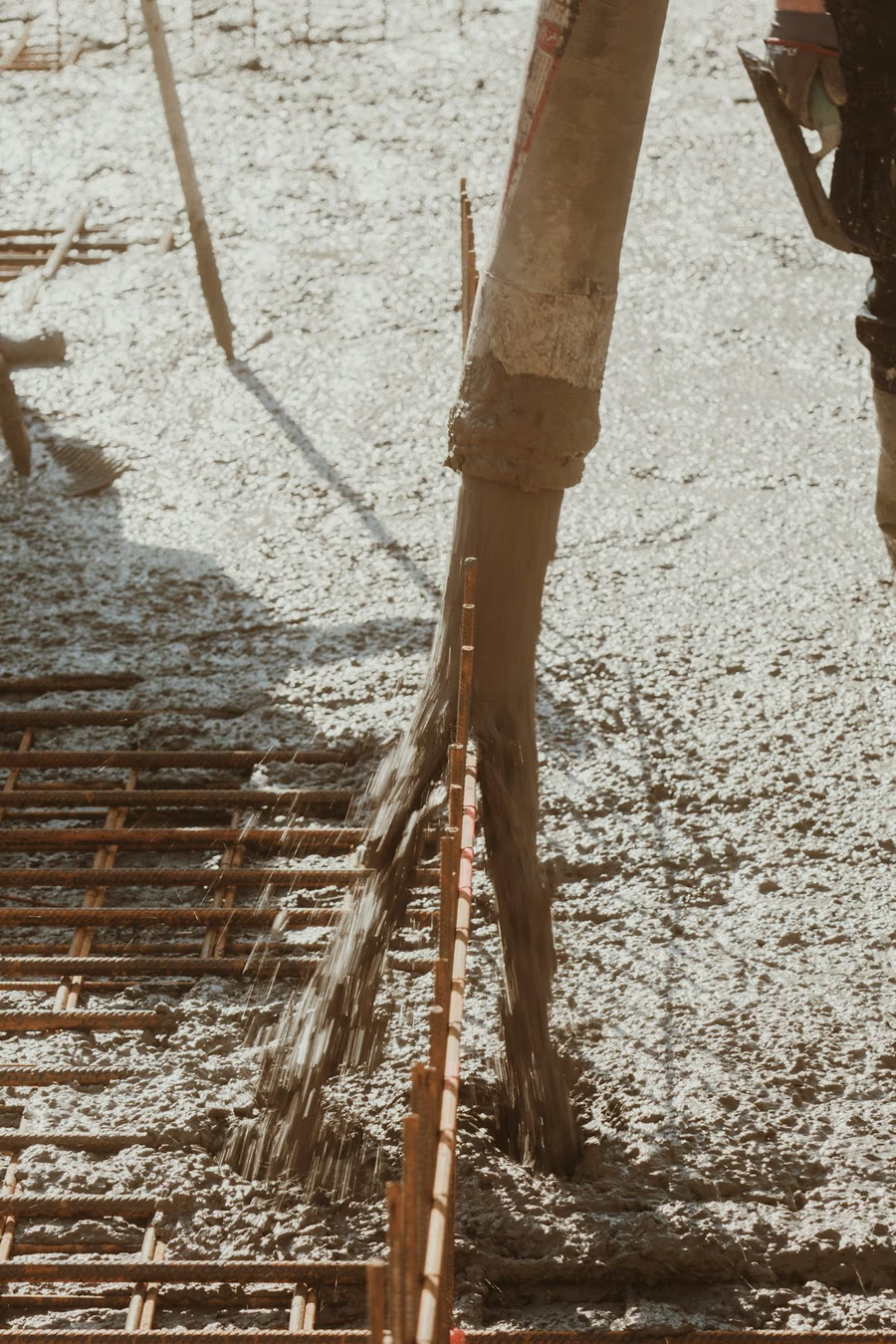
Pouring concrete in a Southeast Texas summer
Concrete does not care what the calendar says, but it cares a great deal about temperature, humidity, wind, and sun. A July pour in Conroe is a harder job than the same pour in March, and knowing why changes what you look for.
Concrete gains strength through a chemical reaction between cement and water, and like most chemistry it goes faster when it is hot. That sounds convenient and is not. Faster reaction means the concrete stiffens sooner, which shortens the window in which it can be screeded, floated, jointed, and finished. Everything that has to happen while the concrete is still workable has to happen faster, with the same number of hands.
What goes wrong in the heat
The finishing window closes early
A crew that comfortably finishes a six-hundred-square-foot drive in spring can find the far end setting up while they are still working the near end in August. The visible outcome is inconsistent surface texture, joints tooled at different stiffnesses, and in the worst case a section that had to be finished after it was really ready to be left alone. On decorative work the effect is worse, because stamping mats have to be pressed within an even narrower window and a stamp that goes in late reads shallow and uneven.
Plastic shrinkage cracking
This is the specific summer failure worth recognizing. While concrete is still plastic, water rises to the surface as bleed water. When the surface loses moisture to evaporation faster than bleed water can replace it, the top skin shrinks against concrete underneath that is not shrinking yet, and fine cracks open in the surface, often short, roughly parallel, and randomly distributed rather than following joints.
The conditions that cause it are hot air, hot concrete, low humidity, wind, and direct sun, and they combine rather than acting alone. A breezy dry afternoon can do it at a temperature that would be harmless still and humid. It is worth knowing that these cracks form before the concrete has any strength at all, so they are not a sign that the slab is weak, but they are a sign that conditions got ahead of the crew.
Cold joints between loads
On a pour needing more than one truck, a gap between loads that would be irrelevant in cool weather can be long enough in summer for the first placement to start setting, leaving a visible line and a weakened plane where the two meet. This is a scheduling and logistics problem more than a materials one, which is why an experienced crew books trucks differently in July.
Water added on site
The most damaging summer shortcut is the easiest one. Concrete stiffening in the chute is harder to place, and adding water makes it flow again. It also raises the water-cement ratio, which lowers the final strength and produces a weaker surface skin that scales later. Where a mix needs to stay workable longer, the correct answer is an admixture ordered with the load, not a hose on site.
How crews work around it
- Start early. A pour that begins at first light finishes before the worst of the afternoon. This is the single biggest lever and it costs nothing.
- Cool the mix. Chilled water or ice in the batch lowers the concrete's own temperature, which slows the set from the inside.
- Shade and windbreaks. Evaporation is driven as much by wind and sun as by air temperature, and temporary shade over a slab makes a measurable difference.
- Fog and evaporation retarders. A fine mist over the surface, or a sprayed retarder film, keeps the top skin from drying ahead of the bleed water.
- Dampen the subgrade. Dry ground and dry forms pull water out of the bottom of a slab. Wetting them beforehand, without leaving standing water, removes that.
- More hands. A larger finishing crew is how a shorter window gets covered, and it is a real cost that belongs on a summer quote.
- Admixtures rather than water. Retarders and water reducers keep a mix workable without weakening it.
- Cure immediately and keep it up. Curing compound, sheeting, or wet cure applied as soon as finishing allows, and maintained rather than stopped when the surface looks dry.
Curing is where summer slabs are won
Curing and drying are not the same thing, and conflating them is where a lot of surface durability disappears. Curing means keeping the concrete moist so hydration continues. A slab that looks dry on the surface after a hot afternoon has lost moisture, not gained strength, and if curing stops there, the top layer never develops the strength of the concrete below it. That is the origin of most scaling and dusting, and it shows up years later rather than immediately.
It is worth asking specifically what curing method will be used and for how long, because it is cheap, it is invisible, and it is the easiest thing to shorten on a hot day when everybody wants to go home.
Should you just wait for cooler weather?
Usually not, and in Conroe waiting has its own costs. The cooler months here bring the wet season, and December through April is exactly the window when USDA records a perched water table sitting fifteen to twenty-eight inches down in the Splendora soil series. A saturated subgrade is a harder thing to prepare and compact than a hot afternoon is to work around, and a rain delay can push a job by weeks rather than hours.
Spring and autumn are the comfortable windows and they are also the busy ones. A well-run summer pour, started early and cured properly, produces a slab indistinguishable from a spring one. A badly run pour in any season does not. The season is a reason to ask better questions, not a reason to postpone.
What to expect on a summer pour date
- An early start, often before seven, and a crew already on site when the first truck arrives
- The subgrade and forms dampened before placing
- More people working the slab than you might expect for the area
- Curing compound or sheeting going on sooner after finishing than it would in spring
- Joints cut on a tighter schedule, possibly the same day rather than the next morning
- A conversation about keeping the slab damp for the next several days, and what you should and should not do on it
For the rest of the process, see the cornerstone driveway guide. For why the wet season matters as much as the hot one, see the soil and subgrade guide. And for the decorative version of the summer problem, stamped and stained concrete under a Texas sun.